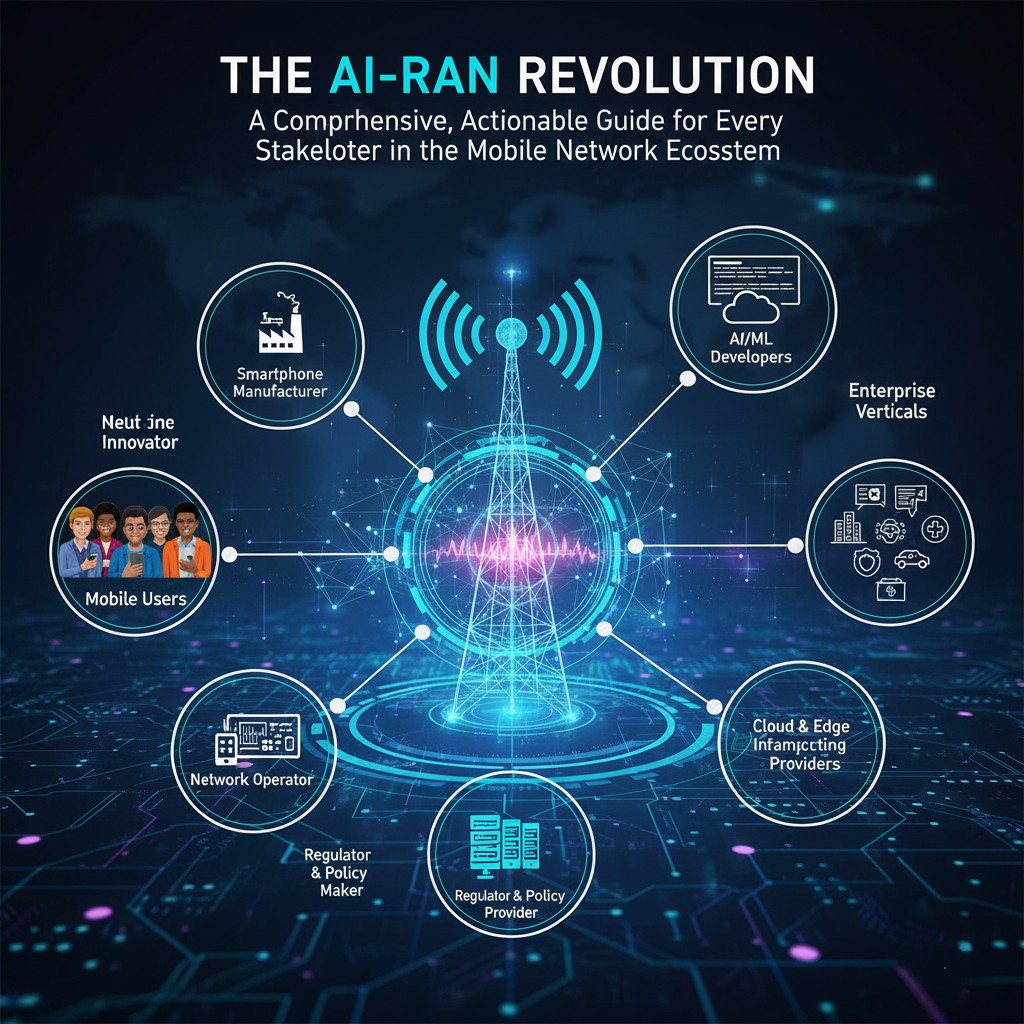
AI-RAN Unlocked: Role-Specific Action Plans for Leaders, RF Engineers, Optimization & Network Teams
Forget the buzzwords. This isn’t about AI in the network. This is about AI redefining the network. The convergence of Artificial Intelligence (AI) and Radio Access Network (RAN) technology – AI-RAN – is not a distant future; it’s the most transformative force currently reshaping mobile networks, impacting every single role from the boardroom to the cell site. This article cuts through the hype to deliver a practical, role-specific roadmap for Leaders, RF Engineers, Optimization Engineers, and Network Engineers. We’ll cover what it is, why it matters now, how it works for you specifically, and what you need to do today.
Why AI-RAN is the Defining Shift (The “Why” for Everyone)
Mobile networks are incredibly complex, expensive to operate, and struggle to keep pace with exploding data demands and new services (5G/6G, IoT, AR/VR, private networks). Traditional network management is reactive, manual, and inefficient. Operators spend ~30% of their operational budget on network operations and maintenance (OPEX), often using outdated tools and siloed data. The cost of poor coverage, dropped calls, and slow speeds translates directly to lost revenue, churn, and brand damage.
AI-RAN solves this by embedding intelligence directly into the RAN layer, moving from static configurations to dynamic, self-optimizing, predictive, and autonomous networks. It’s not just faster; it’s fundamentally smarter.
- For Leaders: This is strategic survival and revenue acceleration. AI-RAN reduces OPEX, boosts network performance (leading to higher ARPU and retention), enables new revenue streams (e.g., premium network slices), and provides a critical competitive moat. Ignoring it means ceding market share to agile competitors leveraging AI-RAN.
- For RF Engineers: This is reclaiming your expertise from manual drudgery. AI-RAN automates tedious tasks, provides deeper insights into signal behavior, and empowers you to focus on high-impact design and troubleshooting.
- For Optimization Engineers: This is elevating your role from “tweaker” to “strategic AI Architect”. You move from rule-based optimization to designing and managing AI models that continuously improve network performance.
- For Network Engineers: This is transforming network management from reactive firefighting to proactive orchestration. You gain powerful tools to predict issues, automate fixes, and ensure seamless service delivery.
The AI-RAN Architecture: Beyond the Hype (The “How” for All)
AI-RAN isn’t one monolithic solution. It’s a stack of integrated capabilities:
- Data Foundation (The Fuel):
- What: Aggregating all relevant data: real-time RAN metrics (UE throughput, RSRP, SINR, interference), network events, KPIs, drive test data, user location, traffic patterns, even external data (weather, events).
- Why it Matters: AI needs high-quality, comprehensive, timely data. Siloed data is useless. Leaders: Invest in data lakes/warehouses now. RF Engineers: Ensure your measurement tools feed into this central pool. Optimization Engineers: Define the critical data streams for your models. Network Engineers: Implement robust data ingestion pipelines.
- AI/ML Engine (The Brain):
- What: Machine Learning models (Supervised, Unsupervised, Reinforcement Learning) trained on the data. Examples:
- Predictive Analytics: Forecasting congestion, predicting cell failures before they happen.
- Anomaly Detection: Identifying subtle signal degradation or security threats instantly.
- Dynamic Optimization: Automatically adjusting antenna tilt, power levels, beamforming, or resource allocation in real-time based on current conditions (e.g., sudden crowd event).
- Automated Troubleshooting: Pinpointing root causes of dropped calls faster than manual analysis.
- Why it Matters: This is the core innovation. Leaders: Prioritize partnerships with vendors offering open, interoperable AI platforms (avoid vendor lock-in!). RF Engineers: Understand which models impact your physical layer parameters (e.g., beamforming adjustments). Optimization Engineers: Become experts in model selection, training, and validation – this is your new core skill. Network Engineers: Focus on integrating AI outputs into your orchestration tools (e.g., automatically triggering a cell split when AI predicts congestion).
- What: Machine Learning models (Supervised, Unsupervised, Reinforcement Learning) trained on the data. Examples:
- Orchestration & Control Plane (The Nervous System):
- What: The interface between AI models and the physical network. It translates AI recommendations into actionable commands (e.g., “Adjust antenna sector 3 by -2 degrees,” “Migrate 500 UEs to neighbor cell X”).
- Why it Matters: Leaders: Demand open interfaces (e.g., O-RAN Alliance specifications) to ensure flexibility. RF Engineers: Need clear, safe control parameters – AI shouldn’t override critical RF safety limits. Optimization Engineers: Must design reliable, safe control policies. Network Engineers: This is where your SDN/NFV expertise becomes crucial for seamless AI-driven automation.
Role-Specific Deep Dive: What AI-RAN Means For You (The “What’s In It For Me?”)
1. For Leaders (CEOs, CTOs, Network Executives): Your Strategic Imperative
- The Pain Point: Rising OPEX, stagnant revenue per user, inability to deliver consistent high-quality experience, slow response to market changes.
- AI-RAN as the Solution:
- Slash OPEX: Automate 30-50% of routine optimization and troubleshooting tasks (e.g., Ericsson reports 30% reduction in drive tests, 40% faster fault resolution). Example: A major European operator saved $150M annually on network operations via AI-RAN.
- Boost Revenue & Retention: Deliver consistently high performance (speed, reliability) – the #1 driver of customer satisfaction. Enable premium services (e.g., ultra-reliable low-latency slices for enterprise IoT) because AI ensures performance SLAs. Example: AI-RAN enabled a US carrier to offer guaranteed 1ms latency for a critical manufacturing client, securing a $50M contract.
- Accelerate Innovation: Deploy new services (e.g., private 5G networks, AR experiences) faster and more reliably. AI-RAN makes network customization feasible at scale.
- Gain Competitive Edge: Be the operator known for the best experience, not just the most coverage. AI-RAN is a key differentiator.
- Your Action Plan TODAY:
- Mandate an AI-RAN Strategy: Don’t just pilot. Build a phased, measurable roadmap with clear KPIs (e.g., “Reduce network-related customer complaints by 25% in 18 months,” “Cut OPEX for RAN optimization by 35%”).
- Invest in Data: Prioritize data aggregation and quality before AI. This is non-negotiable.
- Demand Openness: Require vendors to adhere to O-RAN standards (e.g., O-RAN Alliance, 3GPP). Avoid proprietary black boxes.
- Build Cross-Functional Teams: Create a dedicated AI-RAN task force with RF, Optimization, and Network engineers reporting directly to you.
- Start Small, Scale Fast: Pilot AI-RAN on a specific, high-impact use case (e.g., predictive cell failure for a high-traffic metro area) within 6 months.
2. For RF Engineers: Your Expertise is the Foundation (No Longer the Bottleneck)
- The Pain Point: Manual drive testing is slow, expensive, and misses dynamic issues. Troubleshooting signal degradation is often guesswork. Antenna optimization is static.
- AI-RAN as the Solution:
- Automate Routine Tasks: AI analyzes all signal data (including from UE-side measurements) to flag potential coverage holes or interference before users complain. You no longer need to drive 500km for a single issue.
- Deepen Your Insight: AI reveals hidden patterns (e.g., “Signal degradation correlates with specific weather + time of day + pedestrian density”). You can understand the why, not just the what.
- Optimize Dynamically: AI suggests real-time adjustments to beamforming patterns, antenna tilt, or power based on live traffic and interference – far beyond manual planning. You become the “AI mentor,” guiding the model’s actions.
- Focus on High-Value Design: Shift from reactive fixes to proactive network design using AI-generated insights for new sites or capacity upgrades.
- Your Action Plan TODAY:
- Master Data Context: Understand what data your AI models use (e.g., CSI-RS measurements, PMI reports). Work with Optimization Engineers to define critical RF data streams.
- Learn AI Fundamentals: Don’t need to code, but understand how models work (e.g., “This model uses RF KPIs X, Y, Z to predict interference”). Ask: “What RF parameters does this model actually use?”
- Collaborate on Model Validation: Be the RF expert validating AI recommendations. “This beam adjustment suggestion would cause co-channel interference in sector B – reject it.” Your domain knowledge is the guardrail for AI.
- Embrace New Tools: Learn to use AI-powered RF planning and visualization tools (e.g., vendor-specific platforms showing AI-identified hotspots).
3. For Optimization Engineers: Your Role Evolves (From Tweaker to AI Architect)
- The Pain Point: Rule-based optimization (e.g., “If RSRP < -110, increase power”) is inflexible, leads to suboptimal performance, and can’t handle complex interactions.
- AI-RAN as the Solution:
- Move Beyond Rules: Design and manage ML models that optimize for multiple, conflicting goals simultaneously (e.g., “Maximize throughput while minimizing interference and saving energy”).
- Predictive Optimization: Models learn from historical patterns to anticipate congestion (e.g., “Traffic will surge at 6 PM near Stadium X – pre-allocate resources”).
- Adaptive Optimization: Models continuously learn from new data, improving performance without manual reconfiguration.
- Automated Closed-Loop: The model receives feedback (e.g., “UE throughput increased after adjustment”) and self-improves.
- Your Action Plan TODAY:
- Become an AI Specialist: Deepen your ML knowledge (focus on applied ML for optimization: regression, classification, reinforcement learning). This is your new core competency.
- Define Problem & Data: Precisely define the optimization problem (e.g., “Reduce handover failures in dense urban areas”) and identify the critical data needed for the model.
- Focus on Model Validation & Explainability: You must be able to explain why the AI made a decision (“The model identified high interference from Cell Y during peak hours, so it recommended beamforming adjustment to Cell Z”). Trust is essential.
- Design for Safety & Compliance: Build in constraints (e.g., “AI cannot reduce cell power below X dBm to maintain coverage”) – this is non-negotiable. Your models must be safe.
- Collaborate with RF Engineers: Your models must respect RF physics and constraints. Involve them in model design.
4. For Network Engineers: Your Network Becomes Proactive (From Firefighter to Strategist)
- The Pain Point: Constant firefighting of network outages and performance dips. Manual processes can’t keep up with dynamic traffic.
- AI-RAN as the Solution:
- Predictive Maintenance: AI predicts which cell or component is likely to fail days in advance, allowing proactive replacement before users are impacted.
- Automated Remediation: AI detects an issue (e.g., “Cell X experiencing high drop rate”) and automatically triggers a fix (e.g., “Redirect traffic to neighbor cell Y,” “Adjust scheduling parameters”).
- Dynamic Resource Orchestration: AI continuously allocates radio resources (spectrum, bandwidth, processing) based on real-time demand patterns, not static schedules.
- Enhanced Service Assurance: AI correlates network events across layers (RAN, Core) to pinpoint root causes instantly, drastically reducing MTTR (Mean Time to Repair).
- Your Action Plan TODAY:
- Integrate AI Outputs into Orchestration: Ensure your SDN/NFV and OSS/BSS platforms have APIs to ingest AI recommendations and trigger actions (e.g., via Ansible, Kubernetes operators).
- Focus on Automation Workflows: Design and implement the playbooks that AI triggers (e.g., “If AI detects congestion in Cell A, execute workflow: 1. Check neighbor load, 2. Trigger cell split, 3. Verify throughput”).
- Leverage AI for Service Quality: Use AI insights to proactively manage SLAs for different services (e.g., “Ensure premium gaming slice maintains <5ms latency”).
- Collaborate with Optimization Engineers: Understand the AI models driving resource allocation decisions. Your network must be configurable to respond to AI commands.
Critical Challenges & How to Overcome Them (The Reality Check)
AI-RAN isn’t magic. It requires careful navigation:
- Challenge: Data Quality & Silos: Garbage in = garbage out.
- Solution: Leaders must mandate data governance. Invest in unified data platforms now. Start with critical RF and performance data.
- Challenge: Model Bias & Explainability: AI making bad decisions you can’t understand.
- Solution: Optimization Engineers must prioritize explainable AI (XAI). Validate models rigorously with RF Engineers. Never deploy a black box model on the live network.
- Challenge: Integration Complexity: Making AI work with legacy systems.
- Solution: Demand open interfaces (O-RAN, 3GPP APIs). Start with new greenfield deployments or well-defined upgrade paths. Avoid monolithic, proprietary solutions.
- Challenge: Skills Gap: Lack of engineers who understand both AI and RAN.
- Solution: Invest in targeted upskilling. Cross-train engineers. Partner with vendors for specialized training. This is a strategic investment, not a cost.
- Challenge: Security & Privacy: AI models processing sensitive network data.
- Solution: Implement robust data anonymization and encryption. Ensure AI systems comply with regulations (GDPR, etc.). Security is a prerequisite, not an afterthought.
The Future is Already Here (And It’s Not Just 6G)
AI-RAN is not a future 6G concept. It’s being deployed today by leading operators globally:
- China Mobile: Using AI-RAN for predictive cell failure, reducing O&M costs by 30%.
- Deutsche Telekom: Leveraging AI for dynamic spectrum sharing and energy savings (up to 30% reduction).
- AT&T: Implementing AI for real-time interference management and automated network tuning.
- Nokia & Ericsson: Offering AI-RAN solutions integrated into their RAN platforms (e.g., Nokia’s “AI-Driven RAN,” Ericsson’s “AI for RAN”).
This is the new baseline. Operators not embracing AI-RAN will fall behind on cost, performance, and innovation.
Your Call to Action: The Time for AI-RAN is NOW
- Leaders: Stop debating. Build your AI-RAN strategy, fund it, and mandate cross-functional collaboration. Your competitors are already moving.
- RF Engineers: Become the indispensable AI-RAN expert. Understand the data, validate the models, and guide the AI with your deep RF knowledge.
- Optimization Engineers: Embrace AI as your core skill. Stop optimizing with rules; start designing intelligent systems. Learn ML deeply.
- Network Engineers: Integrate AI into your automation fabric. Make your network responsive to AI-driven insights and actions.
AI-RAN isn’t about replacing engineers. It’s about amplifying their expertise to solve problems that were previously impossible. It’s about building networks that are not just functional, but intelligent – predicting, adapting, and delivering exceptional experiences before users even notice a problem.
The cost of inaction is far greater than the investment in AI-RAN. The operators who lead this transformation today will define the mobile network experience for the next decade. The tools are here. The data is available. The time for strategic action is now. Start your AI-RAN journey today – not tomorrow.
Final Thought for All: AI-RAN is the most significant evolution in network architecture since the shift from 2G to 3G. It’s not a technology you add to your network; it’s the new operating system for your network. Embrace it, master it, and lead the transformation. The future of mobile connectivity depends on it.